

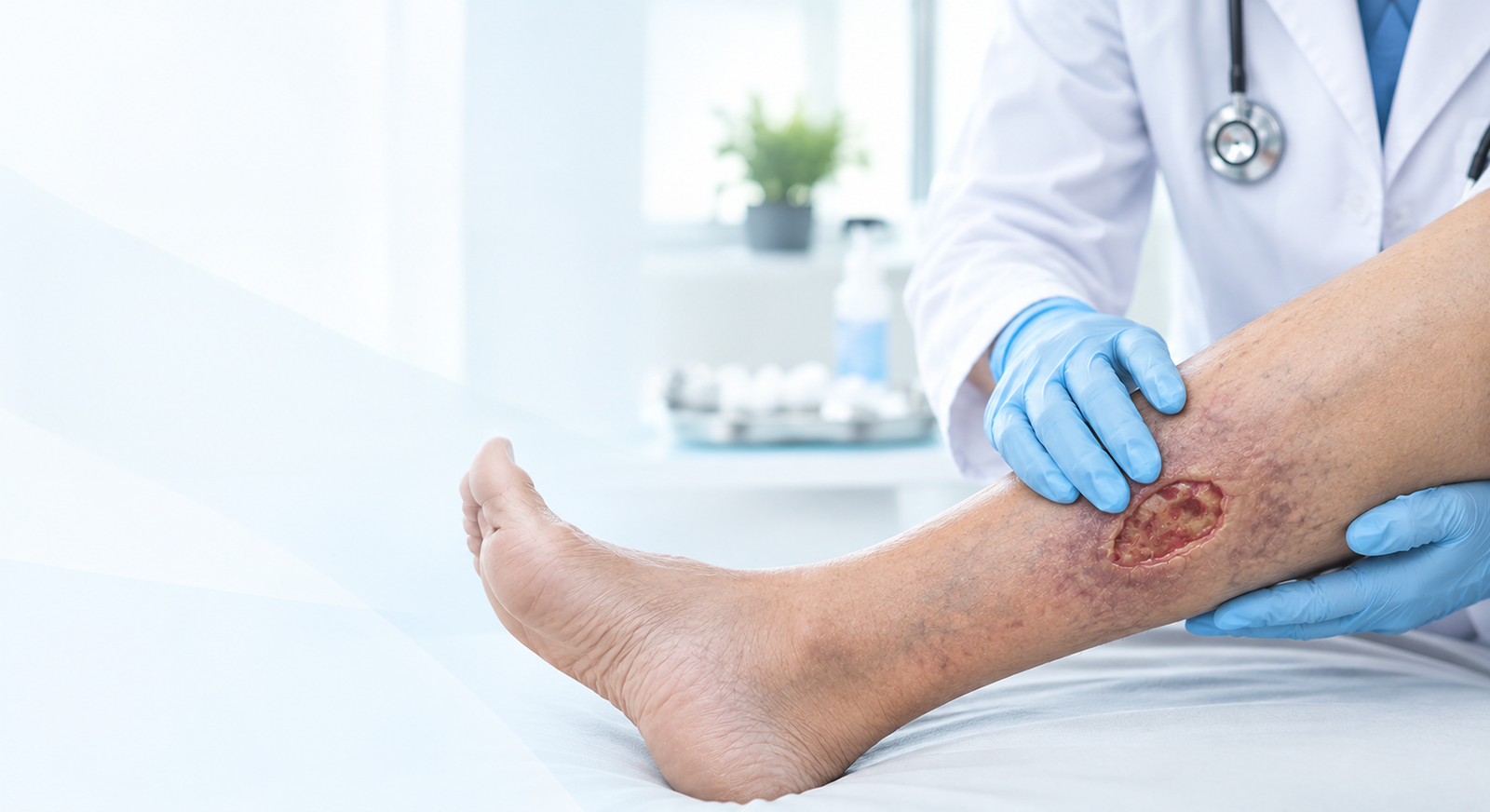
A venous ulcer is a slow-healing open wound, usually near the inner ankle, caused by poor blood flow from the legs back to the heart. Signs include swelling, skin discoloration, itching, and a shallow wound that lingers for weeks, so getting checked early for venous ulcer treatment in Hyderabad can stop the wound from growing or coming back.
Medical Disclaimer: This article is for general educational purposes only and is not a substitute for professional medical diagnosis or treatment. Please consult a qualified doctor or vascular surgeon for evaluation of any leg wound or vein-related symptoms.
What Is a Venous Ulcer?
A venous ulcer, also called a venous leg ulcer or stasis ulcer, is an open sore that forms when the veins in the legs cannot push blood back up to the heart efficiently. Healthy leg veins have small one-way valves that keep blood moving upward. When these valves weaken, blood pools in the lower legs and pressure builds inside the veins. This condition is known as chronic venous insufficiency. Over time, the raised pressure damages the skin and underlying tissue, until even a small knock or scratch can turn into a wound that struggles to close. Venous ulcers are the most common type of chronic leg wound, and they often appear in people who have had [varicose veins] (internal link) or leg swelling for years.
Why Do Venous Ulcers Develop?
The root cause is sustained high pressure in the leg veins. When blood pools instead of flowing upward, fluid and proteins leak into the surrounding tissue. This causes swelling, inflammation, and gradual changes in the skin, which becomes thinner, harder, and less able to repair itself.
Several factors can raise the likelihood of this happening:
- Long-standing varicose veins or a history of vein problems
- A previous deep vein thrombosis (blood clot in a leg vein)
- Jobs or routines involving long hours of standing or sitting
- Excess body weight, which adds pressure on leg veins
- Pregnancy, particularly multiple pregnancies
- Reduced mobility or weak calf muscles, since the calf acts as a pump for leg veins
- Older age and a family history of vein disease
Having one or more of these does not mean an ulcer will form, but it does mean leg wounds deserve closer attention.
What Are the Signs Your Leg Wound Could Be a Venous Ulcer?
Venous ulcers follow a fairly recognizable pattern. A leg wound may be venous in origin if you notice:
- Location around the inner ankle or lower calf, often called the "gaiter area"
- A shallow wound with irregular, uneven edges
- A red or yellowish wound base, sometimes with fluid or weeping
- Ankle or lower-leg swelling that worsens by evening and improves after rest or elevation
- Brownish or reddish-purple staining of the skin around the wound
- Itchy, dry, or scaly skin on the lower leg (venous eczema)
- Hardened, tight, or shiny skin above the ankle
- A heavy, aching, or tired feeling in the legs, especially after standing
- Visible varicose veins nearby
- A wound that has not healed after two to four weeks despite basic care
Pain levels vary. Many venous ulcers are only mildly painful and feel better when the leg is raised. Doctors use this to tell them apart from arterial ulcers, which often hurt more when the leg is elevated.
How Is a Venous Ulcer Diagnosed and Treated?
Diagnosis begins with a clinical examination of the wound, the surrounding skin, and the leg veins. A doctor will usually check the pulses in the feet to make sure the arterial blood supply is adequate, because some treatments depend on this. A venous Doppler ultrasound is commonly used to see which veins have faulty valves and how blood is flowing. An ankle-brachial index (ABI) test may be done to rule out arterial disease, and a swab may be taken if infection is suspected.
Treatment typically works on two fronts: healing the wound and correcting the vein problem behind it.
- Wound care: regular cleaning, removal of dead tissue, and moisture-balancing dressings through [advanced wound care] (internal link)
- Compression therapy: specialized bandages or stockings, one of the most important parts of healing, as they reduce pressure and swelling in the leg
- Elevation and movement: raising the leg and gentle walking to activate the calf muscles
- Treating the faulty veins: to reduce the chance of recurrence, a vascular surgeon in Kondapur may recommend minimally invasive procedures such as endovenous laser or radiofrequency ablation, sclerotherapy, or other options decided after imaging
What Happens If a Venous Ulcer Is Left Untreated?
Without proper care, a venous ulcer can slowly enlarge, become infected, and spread into the surrounding skin as cellulitis. Long-standing ulcers can cause ongoing pain, odor, and reduced mobility, which affect sleep, work, and daily life. Repeated breakdown can leave the skin permanently scarred and fragile. In rare cases, wounds that have been open for many years can undergo changes that need a biopsy. The biggest risk is recurrence: if the vein problem is not addressed, ulcers that heal frequently return.
How Can You Reduce the Risk of Venous Ulcers?
Good vein health habits can lower the risk of a first ulcer and help prevent recurrence:
- Wear compression stockings if prescribed, and replace them as advised
- Raise your legs above heart level for short periods during the day
- Walk regularly, and do simple ankle pumps if you sit or stand for long periods
- Avoid staying in one position for hours at a stretch
- Moisturize the skin on your lower legs to prevent cracking
- Protect your legs from bumps and scratches, especially around the ankles
- Maintain a healthy weight to ease pressure on leg veins
- Get varicose veins or recurring swelling evaluated rather than ignored
When Should You See a Specialist?
Consult a specialist if a leg wound has not improved within two weeks, keeps reopening in the same spot, or appears alongside ankle swelling, skin darkening, or varicose veins. Seek prompt care if you notice spreading redness, warmth, increasing pain, pus, fever, or a bad smell, as these can point to infection. People with diabetes or known circulation problems should have any new leg wound checked early, since mixed causes can change how the wound needs to be treated.
Expert Insight
A frequent mistake is treating a venous ulcer purely as a skin problem, applying creams and dressings for months without looking at the veins underneath. The wound is often a surface sign of a deeper circulation issue, so dressings alone may lead to slow healing or repeated breakdown. Another common gap is stopping compression once the wound closes. Because vein pressure usually remains, giving up compression early can allow the ulcer to return. Vascular and wound care specialists generally emphasize that a correct diagnosis, consistent compression, and treating the faulty veins together give better and longer-lasting results than any single dressing or ointment.
The 4-L Leg Wound Check
Use this quick check as a starting point to understand your wound better, not as a substitute for diagnosis:
- Location – Is the wound near the inner ankle or lower calf? This area is typical of venous ulcers.
- Look – Is it shallow, with uneven edges and a moist, weeping base? Is the skin around it stained brown or purple?
- Leg – Does the leg swell during the day and feel heavy, with visible veins or itchy, hardened skin?
- Length of time – Has the wound been open for more than two weeks, or has it healed and returned before?
If you answer yes to two or more of these, it is worth having the wound and leg veins assessed by a specialist.
Venous Ulcer vs. Other Common Leg Wounds
| Feature | Venous Ulcer | Arterial Ulcer | Diabetic Foot Ulcer |
|---|---|---|---|
| Usual location | Inner ankle, lower calf | Toes, heel, outer ankle, shin | Soles, toes, pressure points of the foot |
| Appearance | Shallow, irregular edges, moist | Deep, "punched-out," dry, pale base | Often surrounded by thick callus |
| Surrounding skin | Brown staining, swelling, eczema | Shiny, hairless, cool skin | Dry or cracked, may feel numb |
| Pain | Mild to moderate, eases when leg is raised | Often severe, worse when leg is raised | Often little pain due to nerve damage |
| Main cause | Faulty vein valves, poor return flow | Narrowed arteries, reduced blood supply | Nerve damage and pressure, sometimes poor circulation |
This table is a general guide only; many wounds have mixed causes, and a doctor's assessment is needed to confirm the type.
Frequently Asked Questions
How do I know if my leg wound is a venous ulcer?
A shallow, slow-healing wound near the inner ankle with swelling and skin discoloration is often venous, but a doctor needs to confirm it.
How long does a venous ulcer take to heal?
Many heal within a few weeks to months with proper compression and wound care, though larger or older ulcers may take longer.
Are venous ulcers painful?
They are usually mildly to moderately painful and tend to feel better when the leg is elevated.
Can a venous ulcer come back after healing?
Yes, recurrence is common unless the underlying vein problem is treated and compression is continued as advised.
Is surgery needed for venous ulcers?
Not always, but minimally invasive vein procedures are often recommended to treat faulty veins and lower the chance of recurrence.
Taking the Right Next Step for a Non-Healing Leg Wound
A leg wound that lingers for weeks is rarely just a skin issue. It is often the body signaling a problem with circulation in the veins. Recognizing the signs early, such as ankle swelling, skin staining, and a wound that refuses to close, gives you the best chance of faster healing and fewer recurrences. At Ikigai Hospitals, vascular surgeons and wound care specialists work together to treat both the wound and the vein disease behind it, using imaging-guided diagnosis, compression therapy, and minimally invasive vein procedures where appropriate. If you recognize these signs in your own legs, booking an evaluation for venous ulcer treatment in Hyderabad is a sensible step rather than waiting for the wound to worsen.
This article is intended for general awareness and does not replace a professional medical consultation. If you have a leg wound that is not healing, please consult a qualified doctor promptly.